



Lesson & Activities - Learn How To Write A Good Email
Updated: May 3


✦ This lesson includes these sections:
☞ PART 3 - Email Writing Vocabulary
☞ LISTENING - Introduction To Email Writing
☞ ACTIVITY 2 - Email Vocabulary Matching Activity
☞ PART 4 - Tips For Writing Good Emails
☞ PART 5 - Writing Email Addresses Correctly
☞ ACTIVITY 3 - Spot The Email Address Mistake
☞ PART 6 - The 7 Important Parts Of An Email
☞ PART 7 - Using Titles In Formal Email Greetings Correctly
☞ LISTENING - Using Titles In Email Greetings
☞ PART 8 - Formal and Informal Email Greeting
☞ PART 9 - Formal and Informal Email Closings
☞ PART 10 - Writing A Formal, Semi-Formal & Informal Email
☞ PART 11 - Writing A Formal Email To Your Teacher
☞ ACTIVITY 4 - Naming All Of The Parts Of The Email
☞ PART 12 - Concluding Thoughts
☞ LISTENING - Concluding Thoughts -Writing Good Emails
☞ QUIZ - Test Your Knowledge
✦ Click on each section from above to see it ↑
✦ Click on each title box from below to get back here ↓

Learn How To Write A Good Email


Speaking Activity
Conversation Questions
Instructions:
Listen to and read the conversation questions.
Practice your speaking by answering each question out loud.
See some possible answers to the conversation questions by clicking the side arrows next to each question.
Learn How To Write A Good Email
Conversation Questions
1. Why do we need to write professional emails to teachers or bosses?
“We need to write professional emails to show respect.”
2. What is the difference between formal and informal emails?
“Informal emails are written for friends and family, and formal emails are written for work or school."
3. What greeting should you use when writing to your teacher?
“I should use formal greetings such as: Dear Mr. or Dear Mrs.”
4. What mistakes do most people make when writing emails?
“People mispell the email address or forget to include a subject when writing emails.”
5. How can writing good emails help you in the future?
“Writing good emails can help me at work, in school, and when I communicate with professionals.”

Writing Activity
Pre-Reading Vocabulary
Instructions:
Get a pencil and paper.
Copy the words from below.
Look up the definitions of the words online.
Get to know the definitions of each word
Important Words
Learn How To Write A Good Email
Communicate
Respectfully
Recipient
Subject
Purpose
Formal
Informal
Greeting
reason
Closing
Signature
Spacing

Learn How To Write A Good Email
Instructions:
Read the following text.
Listen to the audio files.
Complete the activities within the lesson.
Note: Reading out loud when learning a new language is important because it helps you practice your pronunciation. When you speak the words, you can hear how they sound, and this will improve your speaking skills.


The Top 10 Ways People Communicate Today
Today, people use many different ways to communicate with each other. We talk to family, friends, classmates, and coworkers every day. Some ways of communicating are in person, and some use phones or the internet. People may choose different ways depending on where they are and who they are talking to. This list shows the top 10 common ways people communicate today, with simple descriptions and examples to help you understand each one.
Here are the top 10 common ways people communicate:
Ways People Communicate #1
Face‑To‑Face Conversations

Description:
Talking in person is very direct. We can see body language and facial expressions.
Example:
Talking with a friend during lunch
Having dinner with your family and sharing news
Chatting with a friend when you meet up
Ways People Communicate #2
Phone Calls

Description:
Phone calls allow us to speak without seeing the person. Tone of voice is important.
Example:
Calling your mom to let her know you arrived safely
Phoning a grandparent to check in
Calling a friend to make plans
Ways People Communicate #3
Text Messages

Description:
Texting is fast and informal. It is common with friends and family.
Example:
Texting a friend, “Want to hang out today?”
Sending a quick message to your sibling
Texting your family group to say you’re on your way home
Ways People Communicate #4
Emails

Description:
Emails are used for school, work, and formal messages. They are clear and organized.
Example:
Emailing a relative who lives far away
Sending photos to family members by email
Writing a longer message to a friend to keep in touch
Ways People Communicate #5
Social Media Messages

Description:
People communicate through platforms like Facebook or Instagram. These messages are usually informal.
Example:
Sending a private message to a cousin on Facebook
Chatting with a friend on Instagram
Replying to a message from a family member on social media
Ways People Communicate #6
Video Calls

Description:
Video calls combine speaking and seeing the other person, like Zoom or Teams.
Example:
Video calling grandparents who live in another city
Having a family video chat for a birthday
Video calling a friend to talk face‑to‑face
Ways People Communicate #7
Voice Notes and Memos

Description:
Voice notes and memos are recorded spoken messages. They are useful when typing is difficult or when you want to explain something more clearly using your voice.
Example:
Sending a voice message to a friend explaining a story
Leaving a voice note for a sibling with a reminder
Recording a message for a family member when typing is inconvenient
Ways People Communicate #8
Group Chats

Description:
These help people communicate in groups, such as classmates or coworkers.
Example:
A family group chat to plan a holiday
A group chat with friends organizing a get‑together
Messaging siblings together in one chat
Ways People Communicate #9
Online Forums

Description:
People ask questions and share ideas online using written messages.
Example:
Asking for advice in a parenting or family forum
Sharing family experiences in a community group
Reading and posting in forums about shared hobbies with friends
Ways People Communicate #10
Letters

Description:
Letters are less common today, but are still used for official communication.
Example:
Writing a holiday card to a relative
Sending a handwritten letter to a grandparent
Mailing a thank‑you note to a family friend
Listening Activity
The Top 10 Ways People Communicate Today
Instructions:
Press the play buttons below.
Listen to the audio file.
Use the reading from above to follow along with the audio file.
The Top 10 Ways People Communicate Today

Writing Practice
Top Ways People Communicate
Instructions:
Get a pencil and paper.
Make a list from 1 to 10.
Read the 10 situations.
Use the chart - Top Ways People Communicate, to match the answers.
Practice your writing by writing the correct type of way people communicate next to each number.
Check your answers by clicking on the side arrows next to each sentence.
Top Ways People Communicate Matching Activity

Situation #1: Ethan writes a short message to his dad to let him know that his work shift is done and he needs a ride home.
Answer: Writing a text message.
Situation #2: Robert sends a private message to his cousin on Facebook to say hello.
Answer: Sending a social media message.
Situation #3: A family wants to plan a holiday together. Everyone sends messages in one shared chat about their holiday plans.
Answer: Writing a group chat
Situation #4: Liam meets his mother at a café every Saturday. They sit together and talk about their week.
Answer: Having a face‑to‑face conversation
Situation #5: Merhawit lives far from her grandmother. She talks to her and sees her on the screen once a week.
Answer: Having a video call
Situation #6: Patricia writes handwritten notes and sends them by mail to a family friend every month.
Answer: Writing a letter
Situation #7: Maya calls her brother on his birthday to wish him a happy birthday. She wants to hear his voice and talk to him directly.
Answer: Making a phone call
Situation #8: Trish is a new mom. She asks questions about being a parent online and reads answers from other moms.
Answer: Writing in an online forum
Situation #9: Sofia needs to send clear information to her teacher. The message is polite and organized.
Answer: Writing an email
Situation #10: Alexandra is busy and does not want to type. So she records her voice to explain something to a friend.
Answer: Sending a voice note or a voice memo

Take Our Poll
Your Preferred Way To Communicate With People
Which Way Do You Prefer To Communicate?
Face-To-Face Communications
Phone Calls
Text Messages
Email

Introduction to Email Writing

Writing an email is an important skill. Emails help us communicate clearly, politely, and professionally. We use emails to talk to teachers, managers, offices, and people we do not know well.
Email writing can be informal or formal.
Informal emails are casual. We write them to friends or family.
Formal emails are polite and respectful. We use full sentences and correct grammar. These are used for teachers, bosses, and official communication.
Learning how to write a good email helps you make a good impression and avoid misunderstandings.

Email Writing Vocabulary

Email Vocabulary #1
To

To:
The To field shows the main person or people who will receive the email.
Email Vocabulary #2
Subject

Subject:
The subject is a short line that tells the reader what the email is about.
Email Vocabulary #3
Carbon Copy - Cc

Carbon Copy - Cc:
Carbon Copy (Cc) is used to send a copy of the email to someone who should see it but does not need to reply.
Email Vocabulary #4
Blind Carbon Copy - Bcc

Blind Carbon Copy - Bcc:
Blind Carbon Copy (Bcc) sends a copy of the email to someone without other people seeing their email address.
Email Vocabulary #5
Send

Send:
To send an email means to deliver it to the people listed in the email.
Email Vocabulary #6
Schedule Send

Schedule Send:
Schedule send lets you choose a future date and time to send an email.
Email Vocabulary #7
Save Draft

Save Draft:
To save a draft means to keep the email without sending it yet.
Email Vocabulary #8
Discard

Discard:
To discard an email means to delete it without saving or sending it.
Email Vocabulary #9
Attach

Attach:
To attach a file means to add a document, picture, or other file to the email.
Listening Activity
Introduction to Email Writing & Important Email Vocabulary
Instructions:
Press the play buttons below.
Listen to the audio file.
Use the reading from above to follow along with the audio file.
Introduction to Email Writing & Important Email Vocabulary

Writing Practice
Email Vocabulary Matching Activity
Instructions:
Get a pencil and paper.
Make a list from 1 to 9.
Read the 9 definitions.
Use the 9 email vocabulary.
Practice your writing by writing the correct email vocabulary next to each number.
Check your answers by clicking on the side arrows next to each sentence.
Email Vocabulary Matching Activity

Definition #1: To add a file to an email. Which email word does this definition describe?
Answer: Attach
Definition #2: A short line that explains what the email is about. Which email word does this definition describe?
Answer: Subject
Definition #3: To keep an email without sending it yet. Which email word does this definition describe?
Answer: Save Draft
Definition #4: The main person or people who will receive the email. Which email word does this definition describe?
Answer: To
Definition #5: To send the email at a later date or time. Which email word does this definition describe?
Answer: Schedule Send
Definition #6: To delete an email without saving or sending it. Which email word does this definition describe?
Answer: Discard
Definition #7: To deliver the email to the recipients. Which email word does this definition describe?
Answer: Send
Definition #8: To send a copy of the email to someone so they can see it. Which email word does this definition describe?
Answer: Carbon Copy - Cc
Definition #9: To send a copy of the email to someone without other people seeing their email address. Which email word does this definition describe?
Answer: Blind Carbon Copy - Bcc
Tips for Writing Good Emails
1. Use the Correct Recipient
Always check that the email address is correct. Sending an email to the wrong person can cause problems.
Example:
2. Write a Clear Subject Line
The subject should be short and clear. It tells the reader why you are writing.
Subject examples:
Question about Homework
Absence Notification
Request for Meeting
A clear subject helps the reader understand your email quickly.
3. Use a Polite Greeting
Start your email with a formal greeting. Always include a comma.
Examples:
Dear Mr. Smith,
Hello Ms. Johnson,
Good morning, Professor Lee,
Greetings Dr. Brown,
To Whom It May Concern,
4. Write a Clear Body (Reason for Writing)
The body is the main part of the email. Explain your reason clearly and politely.
Example:
“I am writing to inform you that I will be absent from class next week due to a family matter.”
5. Be Polite and Respectful
Use polite language such as please, thank you, and I appreciate your time.
6. Keep Sentences Short and Clear
Short sentences are easier to read and understand.
7. Say Thank You
Always thank the reader for their time or help.
Example:
“Thank you for your understanding.”
8. Use a Formal Closing
End your email politely and include a comma.
Examples:
Sincerely,
Best regards,
Kind regards,
Yours faithfully,
Respectfully,
9. Add Your Signature
Write your full name so the reader knows who you are.
Example: Josy Dorane
10. Use Proper Spacing
Leave a space between each part of the email. This makes it easier to read and understand.

The Importance Of Writing Email Addresses Correctly
Writing the correct email address is very important because it determines whether your message reaches the right person. Even a small mistake—one missing letter or symbol—can cause the email to fail or be delivered to the wrong recipient. Unlike spelling mistakes in the email message, an incorrect email address can stop communication completely.
What Happens When People Make Mistakes in Email Addresses
When an email address is written incorrectly, several things can happen:
The email will bounce back with an error message.
The email may be sent to the wrong person.
The recipient will never receive the message.
Important information, deadlines, or instructions may be missed.
The sender may appear unprofessional.

Reading & Writing Practice
Spot The Email Address Mistake Activity
Instructions:
Get a pencil and paper.
Make a list from 1 to 5.
Copy the 5 email addresses.
Each email address has a mistake. Spot the mistakes in each email.
Practice your writing by rewriting the correct email next to the email that has a mistake
Check your answers by clicking on the side arrows next to each email address.
Spot The Email Address Mistakes
What's wrong with this email address?
carly.rse@gmail.com
Answer: Misspelling the Username
Even one missing or extra letter makes the address invalid.
What's wrong with this email address?
maria-jonesgmail.com
Answer: Forgetting or Misplacing the “@” Symbol
The “@” symbol is required in every email address.
What's wrong with this email address?
tony.823@gmial.com
Answer: Typing the Wrong Domain Name. (gmail = domain)
Using the wrong email provider or company domain sends the email to the wrong place.
What's wrong with this email address?
rob. wade@gmail.com
What's wrong with this email address?
nikki_t@gmail.co
Answer: Using the Wrong Email Ending
Using .com, .ca, .org, or .edu incorrectly can lead to delivery failure.
The 7 Important Parts Of An Email

Parts of an Email
Part 1
Recipient

This is the email address of your teacher. Always check it carefully.
Part 2
Subject

The subject tells the teacher what the email is about. It should be short and clear.
Why keep it short? A short subject helps the teacher understand your email quickly.
Examples:
Absence from Class
Homework Question
Request for Help
Part 3
Greeting

Start with Dear and a title. Use a comma.
Formal greetings:
Dear Mr. Smith,
Dear Mrs. Johnson,
Dear Ms. Brown,
Dear Dr. Lee,
Dear Professor Adams,
Part 4
Body / Reason

This is the main message. Explain why you are writing.
Example: “I am writing to tell you that I cannot attend class next week.”
Part 5
Thank You

Thank the teacher for their time.
Example: “Thank you for your understanding.”
Part 6
Closing

End the email politely.
Formal closings:
Sincerely,
Best regards,
Kind regards,
Yours faithfully,
Respectfully,
Part 7
Signature

Write your full name.
Special Note:
Spacing Is Important!

Leave a space between each part of the email. This makes the email easier to read and more polite.

Using Titles In Formal Email Greetings Correctly
Mr. - Mrs. - Ms. - Miss

When we write a formal email, we often use titles like Mr., Mrs., Ms., or Miss. These titles show respect and help us address people correctly. Let's learn what each one stands for and when to use them.
Mr. stands for Mister

"Mr." is a title that is used for a man, and it should be written before a man’s last name.
For example, if a man's name is John Smith, we write "Mr. Smith." It does not matter if he is married or not.
Mrs. stands for Mistress

"Mrs." is a title that is used for a married woman, and it should be written before a married woman's last name.
For example, if a woman's name is Mary Johnson and she is married, we write "Mrs. Johnson."
Ms. stands for Miss

"Ms." is a title that is used for a woman when you are unsure if she is married or not, and it should be written before a woman's last name. It is a neutral title that does not indicate marital status. If you are unsure, Ms. is always a safe choice.
For example, if a woman's name is Sarah Brown, we write "Ms. Brown."
Miss

"Miss" is a title that is used for. a single woman, and it should be written before a single woman's last name.
For example, if a woman's name is Emily Davis and she is not married, we write "Miss Davis."
Using Titles When Writing Emails
When writing emails, it is polite to use these titles. Start your email with a proper formal greeting, such as "Dear" and the correct title. For example:
Dear Mr. Smith,
Dear Mrs. Johnson,
Dear Ms. Brown,
Dear Miss Davis,
Remember to use a comma after the name. This shows respect and makes your email polite. Always check if you know the person's preference for their title. If you are not sure, "Ms." is a safe choice for women.
Listening Activity
Using Titles In Formal Email Greetings Correctly
Instructions:
Press the play buttons below.
Listen to the audio file.
Use the reading from above to follow along with the audio file.
Using Titles In Formal Email Greetings Correctly

Formal and Informal Email Greetings
Formal Greetings | Informal Greetings |
Dear Mr. Smith, | Hi John, |
Dear Ms. Lee, | Hi Sarah, |
Dear Dr. Brown, | Hello Alex, |
Dear Professor Green, | Hey Mike, |
Dear Hiring Manager, | Hey! |
Dear Sir or Madam, | Hi there, |
Dear Customer Service Team, | Hello! |
Dear Team, | What’s up? |
Good morning Mr. Adams, | Hi everyone, |
To whom it may concern, | Hey guys, |

Formal and Informal Email Closings
Formal Closings | Informal Closings |
Sincerely, | Thanks, |
Kind regards, | Thanks so much, |
Best regards, | Cheers, |
Respectfully, | See you, |
Yours truly, | Talk soon, |
With appreciation, | Best, |
Thank you for your time, | Take care, |
Cordially, | Catch you later, |
Yours sincerely, | Bye, |
Faithfully, | 😊 |

Writing A Formal, Semi-Formal & Informal Email
Formal, semi-formal, and informal emails are different in how serious and friendly they sound.
Formal Email Example

A formal email uses polite language, full sentences, and a proper greeting, and it is used for important work or when you do not know the person well.
Semi-Formal Email Example

A semi-formal email is still polite but more relaxed, and it is common for email with coworkers.
Informal Email Example

An informal email is friendly and casual, uses simple words, and is often written to close coworkers or friends.

Writing A Formal Email To Your Teacher
Writing a formal email to a teacher is very important. Learning how to write a proper email to a teacher can help you communicate clearly and politely about your studies. Let's review the parts of the email that must be included in the email:
Parts Of An Email
Recipient – The person you are emailing
Subject – A short reason for your email
Greeting – A polite opening
Body / Reason – Why you are writing
Thank You – Shows appreciation
Closing – A polite ending
Signature – Your name
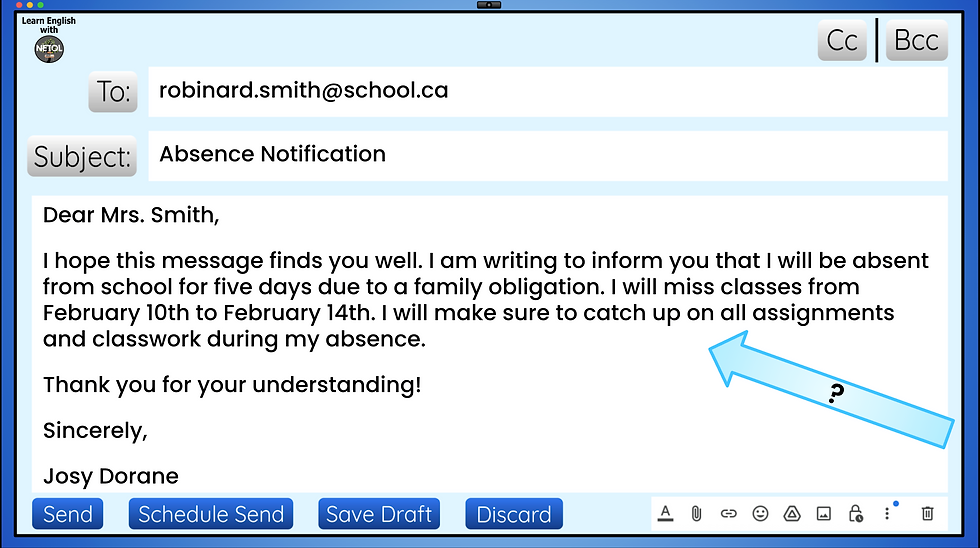
Example Of A Formal Email
From A Student To A Teacher

Parts Of An Email That Is Written To A Teacher
Recipient – robinard.smith@school.com
Subject – Absence Notification
Greeting – Dear Mrs. Smith
Body / Reason – I hope this message finds you well. I am writing to inform you that I will be absent from school for five days due to a family obligation. I will miss classes from February 10th to February 14th. I will make sure to catch up on all assignments and classwork during my absence.
Thank You – Thank you for your understanding
Closing – Sincerely
Signature – Josy Dorane

Writing Practice
Email Vocabulary Matching Activity
Instructions:
Get a pencil and paper.
Make a list from 1 to 9.
Read the 9 definitions.
Use the 9 email vocabulary.
Practice your writing by writing the correct email vocabulary next to each number.
Check your answers by clicking on the side arrows next to each sentence.
Naming All Of The Parts Of The Email

Questions
Question 1: Take a look at the email below. Which part of the email is the orange arrow pointing at?
Answer: Greeting

Question 2: Take a look at the email below. Which part of the email is the red arrow pointing at?
Answer: Closing

Question 3: Take a look at the email below. Which part of the email is the pink arrow pointing at?
Answer: Recipient

Question 4: Take a look at the email below. Which part of the email is the yellow arrow pointing at?
Answer: Thank You

Question 5: Take a look at the email below. Which part of the email is the purple arrow pointing at?
Answer: Signature

Question 6: Take a look at the email below. Which part of the email is the green arrow pointing at?
Answer: Subject

Question 7: Take a look at the email below. Which part of the email is the blue arrow pointing at?
Answer: Body / Reason

Concluding Thoughts On Writing Good Email
In conclusion, people communicate in many different ways today, both in person and by using technology. Each way of communication is useful, depending on the situation and the relationship between the people. Email is one of the most important ways people communicate at school, at work, and in everyday life. Learning how to write emails properly helps us share information clearly, politely, and professionally. Using a clear structure, a good subject line, polite greetings, and correct email addresses can help prevent mistakes and misunderstandings. Good email writing also helps us make a positive impression and show respect to the reader. By improving our email writing skills, we become more confident and better prepared for school, work, and official communication.
Listening Activity
Concluding Thoughts - Writing Good Emails
Instructions:
Press the play buttons below.
Listen to the audio file.
Use the reading from above to follow along with the audio file.
Concluding Thoughts - Writing Good Emails

Test Your Knowledge By Taking Our Quiz
Instructions:
Read the 10 multiple-choice questions from below.
Answer each question.
Click the Submit button when you are done.
Click the View Score button to see how you did on the quiz.


Click below for a reading without the accompanying activities:


Continue teaching this lesson with this resource:


Written by: Nicole WT
Copyright © Learn English with NETOL. All rights reserved.


Comments